

Education for independence and security
Ange Shokano arrived with her family at the Kyaka II Refugee Settlement in 2019. They had fled their village in the Democratic Republic of Congo, which was under constant attack by armed rebel groups. The second-born of seven children, Shokano describes finding peace and stability in Uganda.
Unfortunately, opportunities have been limited. Two years ago, she dropped out of school when her family could not afford the tuition fees.
“My mother was the first person to encourage me to join the mechanics programme”, says Shokano. “She said, ‘I don’t have money to keep you in school, but you can go for this training, and this will help you sustain yourself.’”
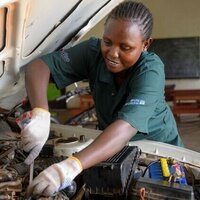
As for Elina Iraguha, she has been in love with cars since she was a little girl, she tells us. “But I used to only see men working as mechanics. How come women can drive – but not repair? I said, ‘What is this!’” she jokes.
“I expect a lot from this course”, explains Iraguha. “I see people with their own businesses because of these skills. My dream is to own my own workshop.”
Busting stereotypes and closing gender gaps
Shokano shares that she had some self-doubts on her first day of training. “I was worried about the energy and strength it would take”, she explains. “Then I realized, ‘It’s you that poisons your mind. I can do anything.’”
Both women describe how supportive their family members have been – though admitted that some needed convincing. “When I told my dad that I applied for the mechanics training, he said, ‘That job is for men! Leave that job for your brothers!’” says Iraguha. “I told him, ‘No, I can do it. Just allow me to try and you’ll see.”
“Once he started to see how well I was managing all the repairs, he was so impressed!”
But Iraguha has concerns that a lack of trust in women mechanics could hurt her future success. “There’s also the community. They say women who do ‘men’s work’ are tough. Many fear them!” She laughs at the thought, then centres herself: “But it is about my own motivation, my will, and what I want to get in life that will push me forward.”
She knows her father is just the beginning. Eventually, no one will be able to argue with the quality of her work.
Women’s success strengthens communities
“I want to earn enough money to start up my own garage, so I can sustain my life, as well as my siblings’”, says Iraguha.
She becomes animated as she describes her vision for the future: “My dream in 10 years is to have my own workshop where I can repair people’s cars and train others in the community. It would be a big workshop that could accommodate up to 50 learners, mostly women. Many women overlook this job because they think it is only for men. And yet it is just a skill. Anyone can learn it.”
After one month of training, Shokano and Iraguha have already mastered tyre repairs and breaks. After six months, they’ll earn their certificates.
Shokano says this is just the beginning for her. She hopes to form a garage with other women in the training programme so they can earn money while advancing their skills. “It’s important for women to focus on themselves. Learn mechanics or hair dressing – whatever skills you need to sustain yourself.”
Education as a foundation for gender equality
The stories of Shokano and Iraguha are reminders that education is not just about books – but about agency. It gives women the tools they need to challenge gender norms, support their families, and uplift communities.
As we mark International Day of Education, their journeys reflect what’s possible when learning meets opportunity.
“Education is the key”, says Shokano. “Education is the key to the doors that had been closed in my future.”